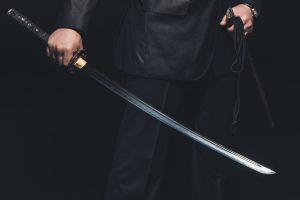
The katana sword stands as a symbol of precision, discipline, and spiritual mastery. Forged in the fires of ancient Japan, this elegant yet deadly weapon has transcended its role as a battlefield tool to become an icon of culture and artistry. Whether displayed in collections, wielded in martial arts, or studied by historians, the katana sword remains a powerful link to samurai honor and craftsmanship.
1. The Katana Sword’s Origins Lie in Samurai Honor
It emerged during Japan’s Kamakura period (1185–1333), when the need for faster, more efficient weapons reshaped battlefield tactics. Samurai warriors sought a blade that reflected both power and elegance — a tool for combat and a mirror of personal virtue. The katana fulfilled that vision, embodying Bushido, the samurai code of honor, loyalty, and discipline.
Each katana sword was viewed not only as a weapon but as an extension of the samurai’s spirit — a balance of deadly sharpness and moral restraint.
2. The Forging Process Blends Science and Spirituality
Creating a katana sword was as much a spiritual ritual as a metallurgical process. Master swordsmiths combined tamahagane steel — derived from iron sand — with precise folding and hammering techniques. The repeated folding purified the metal and distributed carbon evenly, ensuring both flexibility and strength.
The blade’s signature hamon line, the wavy pattern visible along its edge, is a result of differential heat treatment — the spine remains softer for resilience, while the edge becomes razor-sharp. Each sword was blessed before completion, symbolizing purity, craftsmanship, and spiritual harmony.
3. The Design Embodies Perfect Balance
One of the most remarkable features of the sword is its ergonomic design. The curved blade allows for smooth drawing and cutting motions, giving samurai warriors an advantage in close combat.
The balance between the blade, tsuba (guard), and tsuka (handle) allows precise control with minimal effort. The katana sword’s single-edged curvature distinguishes it from double-edged Western swords, emphasizing fluid, efficient motion rather than brute strength.
Even today, martial artists who practice Iaido or Kenjutsu value this design for its elegance and efficiency.
4. The Katana Sword Symbolizes Life and Death
In samurai culture, the katana sword was more than a weapon — it represented a sacred bond between life and death. A samurai’s sword was believed to contain their soul, and losing it was a sign of deep dishonor.
Before battle, warriors performed purification rituals to honor their blades, often meditating on mortality and duty. The katana sword thus became a philosophical tool, reminding its wielder of impermanence, courage, and clarity in the face of danger.
Today, this symbolism continues to attract collectors and spiritual practitioners who see the katana as a representation of balance and mindfulness.
5. The Katana Sword in Modern Martial Arts
Although warfare has evolved, the legacy of the katana sword endures in martial disciplines such as Kendo, Iaido, and Kenjutsu. These arts emphasize not just combat techniques but mental focus, respect, and harmony of movement.
Practitioners learn that mastery of the katana sword begins with mastering oneself. The sword becomes a metaphor for cutting through ignorance, ego, and hesitation — a timeless lesson in both martial and personal development.
Recommended Training Product:
-
Cold Steel Katana Warrior Series – A functional modern replica ideal for martial practice.
-
Pros: Realistic weight, sharp edge, excellent balance.
-
Cons: Requires careful maintenance and storage.
6. Collecting and Preserving the Katana Sword
Collectors worldwide treasure the katana sword for its artistry, rarity, and cultural significance. Authentic antique katanas are considered national treasures in Japan and can fetch extraordinary prices.
Preservation requires precision: oils like choji oil prevent rust, and silk wrapping maintains grip integrity. Display stands allow the blade to rest with the cutting edge upward — both for safety and to honor tradition.
Owning a katana sword today is a gesture of respect toward centuries of craftsmanship and discipline.
Recommended Display Product:
-
Handmade Samurai Katana with Display Stand – Ideal for collectors.
-
Pros: Decorative craftsmanship, carbon-steel blade, traditional saya (scabbard).
-
Cons: Primarily for display, not for cutting practice.
7. The Katana Sword in Pop Culture and Modern Identity
From samurai films to anime and video games, the katana sword remains a symbol of heroism, discipline, and identity. Characters like Kenshin Himura, O-Ren Ishii, and even Luke Skywalker’s lightsaber trace inspiration from its aesthetic.
Modern artisans have adapted the sword into high-end collectibles, ceremonial items, and performance art pieces. Its clean lines, cultural weight, and mythic aura ensure that it continues to captivate imaginations across generations.
In essence, the katana sword is not just a relic — it is a living embodiment of the human pursuit of excellence.
Conclusion
The katana sword remains a timeless fusion of art, philosophy, and engineering. Forged through fire, shaped by spirit, and revered across centuries, it teaches lessons that extend far beyond the battlefield — about balance, purpose, and discipline.
Whether displayed as a masterpiece or wielded with respect, the katana sword continues to inspire awe as one of humanity’s most refined creations — a true reflection of the samurai soul.
Reference
-
Okazaki, Steven. The Art of the Japanese Sword: The Craft of Swordmaking and Its Appreciation. Tuttle Publishing, 2016.
-
Nagayama, Kōkan. The Connoisseur’s Book of Japanese Swords. Kodansha International, 1997.
-
Nihonto Craft Society. “Traditional Katana Forging Techniques.” https://www.nihontocraft.com
-
Japanese Sword Museum. “Preservation of Samurai Swords.” https://www.touken.or.jp