Martial arts weapons have long been an integral part of various combat traditions across the globe, each weapon carrying its own unique history, techniques, and cultural significance. From the nimble nunchaku of Okinawan kobudo to the formidable bo staff used in countless Asian martial arts, these tools of defense and offense showcase the ingenuity and adaptability of ancient warriors. In this comprehensive guide, we explore 100 martial arts weapons, delving into their origins, functionalities, and the role they play in modern martial arts training and practice. Whether you are a seasoned martial artist or a curious enthusiast, this journey through the world of martial arts weaponry promises to be both enlightening and inspiring.
.
1. Introduction
In the realm of martial discipline and combat tradition, the phrase martial arts weapons evokes images of ancient blades, staffs, throwing tools and hidden surprises. Whether for ceremonial, training or lethal purposes, these weapons carry not only physical power but deep historical resonance. In this article we present 100 of the most potent, iconic martial arts weapons — each described with its origins, usage, strengths and caveats. From the razor-sharp curve of the katana to the obscure ngombe sword of Africa, this list spans continents and centuries.
Throughout this journey you’ll encounter the term martial arts weapons again and again — each entry reinforcing how these tools shaped combat systems, training methods, and the human body itself. Let’s begin.
2. Definitions & Scope
Before diving into the list, it’s helpful to define what we mean by martial arts weapons. These are implements designed or adapted for combat (or training in combat arts) which are used in martial arts traditions: striking, thrusting, throwing, entangling, blocking, etc. They may be melee weapons (blades, staffs, clubs) or ranged/entangling tools (chains, darts, throwing axes). Some serve ceremonial or symbolic functions but are rooted in martial contexts.
We choose to cover 100 such weapons to provide a comprehensive panorama — from common staples to rare curios. In each case we’ll consider: history/background, typical martial arts usage, pros and cons, and risks or training considerations. This article is for informational purposes only — handling any weapon requires proper training and awareness of legal and safety issues.
3. Historical Overview of Martial Arts Weapons
3.1 Ancient beginnings
Many of the weapons listed began their life as tools (farming tools, hunting implements) that were adapted for combat. For example, the sickle-like kama began as a farm implement. Over time, martial arts systems incorporated such tools, refining techniques of offense and defence.
3.2 The evolution in martial traditions
Martial arts weapons became codified in training systems: Japanese sword arts (kenjutsu, iaido), Okinawan kobudo, Chinese wushu weapons forms, Indian martial systems, European sword and polearm traditions, and African weapons traditions. These traditions preserved skills, ritual significance and transmission across generations.
3.3 Training and modern relevance
Even in modern times, many martial arts weapons are used in forms, demonstrations and competitive events (such as kobudo, wushu weapons categories). Training with weapons enhances coordination, understanding of range, timing and body mechanics — even if one never uses them in combat.
4. The List of 100 Martial Arts Weapons
Below are descriptions of each weapon in the list, grouped for readability. (Note: For brevity each entry is concise; additional research is encouraged.)
4.1 Traditional Japanese/Okinawan weapons
-
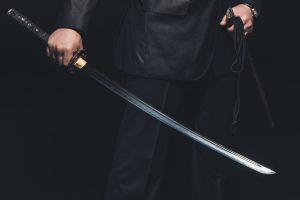
Katana – A traditional Japanese sword known for its sharpness and curved, slender blade. It is iconic in samurai culture and martial arts.
-
Nunchaku – Consists of two sticks connected by a chain or rope. It’s famous for its speed and agility, popularized by Bruce Lee.
-
Bo Staff – A long wooden stick used in various martial arts forms. Its versatility allows for strikes, blocks, and joint locks.
-
Sai – A three-pronged weapon used mainly in Okinawan martial arts. It’s excellent for defense, disarming, and trapping an opponent’s weapon.
-
Tonfa – Tonfa are traditional Okinawan weapons resembling police batons. They are used in pairs for striking and blocking.
-
Kama – The kama is a sickle-like weapon with roots in farming tools. It’s effective in close combat with slashing and hooking techniques.
-
Shuriken – Small, hand-held throwing stars designed for distractions or minor injuries. They come in various shapes and sizes.
-
Bokken – A wooden sword used in training for traditional Japanese swordsmanship. It’s a safer alternative to practicing with a real katana.
-
Jo Staff – A shorter version of the bo staff. It’s used in Japanese martial arts like Aikido and jodo for striking and blocking.
-
Tessen – Folding fans with a hidden weapon aspect. They were used by samurai as both a weapon and a defensive tool.
-
Wakizashi – A shorter Japanese sword often paired with a katana. It’s used for close-quarters combat and in seppuku rituals.
-
Tanto – A small Japanese dagger. It’s known for its use in close combat and ceremonial purposes.
-
Naginata – A pole weapon with a curved blade on the end. It was historically used by samurai and warrior monks.
-
Kusarigama – Combines a kama with a weighted chain. It’s used to entangle and disarm opponents while delivering powerful strikes.
-
Eku – An Okinawan weapon resembling a boat oar. It’s used similarly to the bo staff but allows for sweeping strikes.
-
Tiger Claws – Metal weapons worn on the hands. They mimic the natural weaponry of big cats, allowing for slashing attacks.
-
Hanbo – A half-length bo staff. It’s effective for joint locks, throws, and strikes in close combat.
4.2 Other Asian and Filipino weapons
-
Kamas – Traditional farming sickles repurposed as weapons. They’re used in pairs for slashing and blocking.
-
Tambo – A short stick used in martial arts for strikes and joint locks. It’s versatile and easy to carry.
-
Butterfly Swords – Short, broad-bladed weapons used in pairs. They are effective for close-quarters combat and blocking.
-
Escrima Sticks – Used in Filipino martial arts (such as Eskrima). They are employed in pairs for striking, blocking, and trapping techniques.
-
Chakram – A circular throwing weapon from India. It can be thrown or used in hand-to-hand combat.
-
Kunai – Multi-purpose tools used as weapons in Japanese martial arts. They can be thrown or used in hand-to-hand combat.
-
Dan Bong – A short stick used in Korean martial arts. It’s effective for strikes, blocks, and joint manipulations.
-
Meteor Hammer – A Chinese weapon consisting of a weight attached to a rope or chain. It’s swung to strike or entangle opponents.
-
Rope Dart – A long rope with a metal dart on the end. It’s used in Chinese martial arts for entangling and striking from a distance.
-
Jian – A double-edged straight sword used in Chinese martial arts. It’s known for its agility and precision.
-
Dao – A single-edged Chinese sword with a curved blade. It’s designed for slashing and chopping.
-
Hook Swords – Chinese weapons with curved, hook-like blades. They’re used for slashing, hooking, and trapping.
-
Guandao – A Chinese pole weapon with a large blade. It’s similar to the Japanese naginata and used for powerful strikes.
-
Whip Chain – A flexible Chinese weapon with multiple metal segments. It’s used for rapid, flexible strikes and entanglements.
-
Trident – A three-pronged spear used in various martial arts. It’s effective for thrusting, blocking, and trapping.
-
Urumi – A flexible, whip-like sword from India. It’s used for slashing attacks and requires great skill to wield safely.
-
Yari – A Japanese spear used by samurai. It’s effective for thrusting and slashing in combat.
-
Spear – The spear is a universal weapon found in many cultures. It’s used for thrusting and throwing in various martial arts.
-
Halberd – A pole weapon with an axe blade, spear point, and hook. It’s versatile for both striking and thrusting.
4.3 Tools-turned-weapons & large weapons
-
Scythe – A farming tool repurposed as a weapon. It’s used for wide, sweeping strikes.
-
Battle Axe – A powerful weapon used for chopping and slashing. It’s known for its brute strength and effectiveness.
-
Club – A basic weapon used in many cultures. It’s effective for blunt-force strikes.
-
Mace – A club with a heavy, spiked head. It’s designed to inflict maximum damage with each strike.
-
Flail – Consists of a handle with a chain and spiked ball. It’s used for swinging strikes that bypass shields.
-
Morning Star – Similar to a mace but with a spiked ball on a chain. It’s designed for devastating strikes.
-
War Hammer – A weapon with a hammerhead and spike. It’s used for crushing armor and delivering powerful blows.
-
Crossbow – A ranged weapon that fires bolts. It combines the power of a bow with the mechanical advantage of a trigger.
-
Longbow – A traditional archery weapon. It’s known for its long range and powerful shots.
-
Short Bow – A smaller, more maneuverable bow. It’s effective for quick, close-range shots.
-
Composite Bow – Made from multiple materials for increased strength and flexibility. It’s used for both hunting and combat.
-
Blowgun – A simple ranged weapon that fires darts. It’s used for stealth attacks and hunting.
-
Sling – An ancient ranged weapon that hurls stones. It’s known for its simplicity and effectiveness.
-
Throwing Axe – Designed for throwing at targets. It combines the effectiveness of an axe with the range of a throwing weapon.
-
Tomahawk – A Native American axe used for combat and utility. It’s effective for both throwing and close combat.
4.4 European & Mediterranean blades
-
Gladius – A Roman short sword used by legionaries. It’s designed for thrusting in close combat.
-
Falchion – A single-edged European sword. It’s effective for slashing attacks.
-
Rapier – A slender, thrusting sword used in European duels. It’s known for its speed and precision.
-
Sabre – A curved, single-edged sword used by cavalry. It’s designed for slashing attacks from horseback.
-
Claymore – A large, two-handed sword used by Scottish warriors. It’s effective for powerful, sweeping strikes.
-
Spatha – A long Roman sword used by cavalry. It’s effective for both thrusting and slashing.
-
Khopesh – An ancient Egyptian sickle-sword. It’s designed for slashing and hooking attacks.
-
Kris – A wavy-bladed dagger from Southeast Asia. It’s known for its unique shape and effectiveness in close combat.
-
Kukri – A Nepalese knife with a distinctive curved blade. It’s used for chopping and slashing.
-
Balisong – A folding knife from the Philippines (but listed here). It’s known for its rapid deployment and versatility.
-
Bowie Knife – A large, fixed-blade knife from America. It’s effective for both combat and utility.
-
Dirk – A long Scottish dagger. It’s used for thrusting in close combat.
-
Dagger – A small, double-edged knife. It’s used for stabbing in close quarters.
-
Stiletto – A slender, pointed knife designed for thrusting. It’s known for its piercing ability.
-
Cinquedea – A wide-bladed Italian dagger. It’s designed for thrusting and slashing.
4.5 Indian & Southeast Asian weapons
-
Pata – A sword-gauntlet from India. It combines the protection of a gauntlet with the offensive capability of a sword.
-
Katar – A push dagger from India. It’s used for powerful thrusting attacks.
-
Chakri – Small, circular throwing weapons from India. They’re used for distraction and injury.
-
Kalis – A Filipino sword with a wavy blade. It’s effective for both slashing and thrusting.
-
Karambit – A small, curved knife from Indonesia. It’s designed for slashing and hooking attacks.
-
Langsax – A long, single-edged knife from Northern Europe. It’s used for both utility and combat.
-
Seax – A short, single-edged knife from Northern Europe. It’s used for utility and combat.
-
Trench Knife – A combat knife with a knuckle guard. It’s used for close-quarters combat in trenches.
-
Pugio – A Roman dagger. It’s used for stabbing in close combat.
-
Tanto (non-Japanese) – A knife with a chisel-like point. It’s effective for thrusting and utility.
-
Hunga Munga – An African throwing knife. It’s designed for throwing and close combat.
-
Knobkerrie – A South African club with a rounded head. It’s used for striking in combat.
-
Kpinga – An African throwing knife with multiple blades. It’s used for throwing and close combat.
-
Parang – A Malaysian machete. It’s used for chopping in both combat and utility.
-
Golok – A Southeast Asian machete. It’s used for chopping and utility.
-
Machete – A large knife used for chopping. It’s effective for both utility and combat.
-
Yataghan – A Turkish sword with a curved blade. It’s designed for slashing attacks.
-
Shamshir – A Persian curved sword. It’s used for slashing attacks.
-
Talwar – An Indian curved sword. It’s designed for slashing attacks.
-
Scimitar – A Middle Eastern curved sword. It’s effective for slashing attacks.
-
Bolo Knife – A Filipino machete. It’s used for chopping and utility.
-
Kukri (again for utility) – As above: the kukri is a versatile knife from Nepal. It’s used for both combat and utility.
-
Glaive – A pole weapon with a single-edged blade. It’s used for slashing and thrusting.
-
Dadao – A large Chinese sword. It’s used for powerful slashing attacks.
-
Guan Dao – A Chinese pole weapon. It’s used for powerful strikes.
-
Bardiche – A large, two-handed axe. It’s used for powerful chopping attacks.
-
Billhook – A tooling implement repurposed as a weapon. It’s used for chopping and hooking.
-
Falcata – A curved sword from the Iberian Peninsula. It’s designed for slashing attacks.
-
Kopis – A Greek curved sword. It’s used for slashing attacks.
-
Xiphos – A Greek double-edged sword. It’s used for both thrusting and slashing.
-
Makraka – An African sword. It’s used for slashing attacks.
-
Mambele – An African throwing knife. It’s used for throwing and close combat.
-
Shotel – An Ethiopian curved sword. It’s used for slashing attacks.
-
Ngombe – An African sword associated with the Ngombe people (Congo Basin). It is often ceremonial but has martial roots and is used for slashing attacks. hamillgallery.com+2Wikipedia+2
5. Pros of Training With Martial Arts Weapons
-
Enhanced coordination & proprioception: Training with a staff, sword or chain weapon heightens body awareness, stance alignment and movement precision.
-
Range awareness & timing: Long weapons (e.g., bo staff, guandao) teach you to manage distance; short weapons teach close-quarters control.
-
Historical and cultural connection: Many weapons carry rich heritage, giving practitioners insight into traditions, etiquette and philosophy.
-
Versatility and conditioning: Many weapons workouts double as strength, cardio and mobility training.
-
Mental focus and discipline: Learning complex weapon forms reinforces discipline, concentration and respect for training safety.
6. Cons and Risks
-
Injury potential: A misused sword, chain or hook-weapon can injure the wielder or training partner. Proper supervision and protective gear are essential.
-
Legal/regulatory issues: Some weapons may be restricted in your jurisdiction; check local laws before purchase or public training.
-
Skill curve and false confidence: Having a weapon can create a false sense of security. Mastery takes years. Overconfidence without control is dangerous.
-
Space and cost: Training safely may require space and equipment (training swords, katas, drills). Some weapons are expensive or require special maintenance.
-
Focus on weapon vs fundamentals: Some practitioners may neglect core martial arts fundamentals (stance, footwork, striking) in favour of flashy weapons work. This can weaken overall martial competence.
7. Usage Tips and Safety Guidelines
-
Start slow: If you are new to weapon training, begin with wooden or training versions (e.g., bokken, bo-staff) before live edged/bladed weapons.
-
Focus on fundamentals: Posture, footwork, breathing and awareness are still paramount — weapons amplify but don’t replace fundamentals.
-
Use proper protective gear: Eye protection, gloves, body protection may be warranted depending on weapon and drill.
-
Check your environment: Ensure there is adequate clearance and no bystanders or objects that can interfere.
-
Respect the weapon’s lineage: Many weapons carry cultural tradition — approach training with respect and mindfulness.
-
Learn from qualified instructors: Especially for exotic or concealed weapons (e.g., meteor hammer, kusarigama, urumi) the risk and difficulty are high.
-
Maintain the weapon: Blades need sharpening/honing; staffs may need checking for cracks; chains and ropes need inspection.
-
Legal awareness: Some jurisdictions forbid or restrict certain weapons; always verify before purchasing or training.
8. Research & Modern Context
Martial arts weapons continue to intrigue scholars, martial historians and practitioners. Research often focuses on weapon form evolution, biomechanics of use, and the integration of weapons training into modern martial systems. For example, studies in biomechanics show how staff swinging engages core rotation, and modern wushu competitions feature weapons forms with standardized scoring. Additionally, historical weapon cataloging provides insight into cultural exchange — e.g., how Asian weapons influenced Western systems or how African blade traditions informed local ritual and combat practices.
9. Product / Training Equipment Suggestions
If you’re interested in practising with martial arts weapons, here are a few suggestions (note: choose safe training versions, not live blades unless you have advanced supervision):
-
A wooden bo staff (typically 6’ or 7’) to learn fundamentals of staff handling.
-
A padded nunchaku or sport-version to develop wrist and chain coordination.
-
A bokken (wooden training sword) for safe training of sword-form mechanics.
-
A practice kusarigama with rope ballast (safe version) for entanglement drills under supervision.
-
A training karambit knife (rubber or blunt) for learning curved-blade mechanics in Filipino or Indonesian knife forms.
When selecting equipment, ensure it’s appropriate for your level and that you have space to practise safely.
10. Risks & Ethical Considerations
Using or even owning martial arts weapons comes with responsibility. Misuse can lead not only to personal injury but to legal consequences and harm to others. Ethical training entails: consent, safety, respect for the weapon’s cultural background, and awareness of the weapon’s purpose. Moreover, weapons are tools — they don’t guarantee victory; training, mindset and ethics are equally important.
11. Conclusion
In this expansive tour of 100 martial arts weapons, we’ve covered everything from the legendary katana to the lesser-known ngombe African sword. Each weapon carries its own technical demands, historical weight and training potential. For martial artists willing to explore beyond bare-hand techniques, weapons training offers a deep, rewarding challenge — but it requires dedication, safety, mentorship and respect.
Whether you practise a few forms, explore one weapon deeply, or simply enjoy the history, remember: with great weapon comes great responsibility. Use the power of martial arts weapons wisely — not for spectacle alone, but for growth, discipline and martial integrity.
Reference
Spring, Christopher. African Arms and Armor. Smithsonian Institution Press, 1993. Wikipedia+1